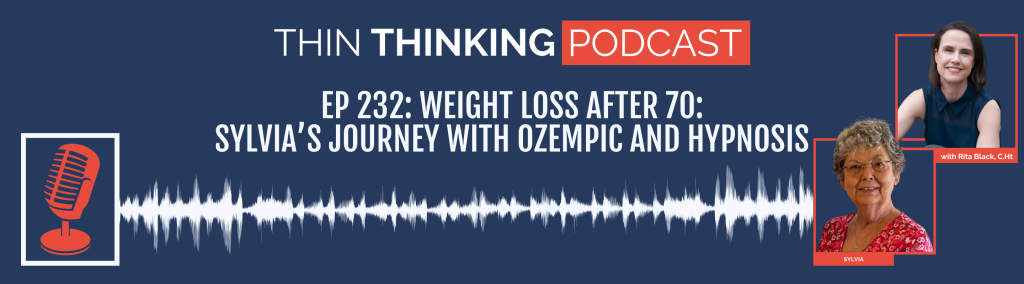
If you’ve been curious about weight loss medications like Ozempic—or maybe you’re already using them—this week’s episode is one you don’t want to miss.

Meet Sylvia from Louisiana. She’s 79 years young and living proof that transformation is possible at any age.

When she started Ozempic, she lost 50 pounds. But with decades of yo-yo dieting behind her, Sylvia knew lasting weight release would take more than a prescription… it would take a mindset shift.

In this powerful conversation, it is a reminder that the real magic isn’t in the medication—it’s in the mind.

Tune in now to hear Sylvia’s inspiring journey and learn how mindset can amplify any weight loss strategy.

LIVE FREE ONLINE MASTERCLASSES
With Weight Loss Hypnosis
AUGUST 13-16

Mastering Your Mindset for Permanent Weight Release

Join me (Rita) Live for my FREE Masterclass where I will be teaching you how to use your subconscious mind more effectively for permanent weight release.

STOP…

  • The constant thinking about your weight and food…
  • The exhausting inner battle between the part of you that wants to lose weight and the part that wants to impulsively eat…
  • The fear that you are never going to find a way out of this weight struggle hell…

START…

  • Getting the mental edge over your weight, eating and exercise habits
  • Knowing that you can end the struggle for good
  • Feeling confident and ready-you’ve got this!

I look forward to starting a powerful weight release journey with you…

In This Episode, You’ll Learn:

How Sylvia combined Ozempic with the Shift Weight Mastery Process and weight loss hypnosis.

How she continued releasing weight even after hitting a plateau.

The daily habits she changed that made lasting mindset changes.

Subscribe and Review

Have you subscribed to the podcast yet? If not, go ahead and click the ‘subscribe’ button for your favorite podcast platform! You don’t want to miss a single episode.

If you enjoyed this episode, it would be very helpful to us if you would leave an honest review on Apple Podcasts. This review helps people who are on the same weight loss journey as you to find us and soak up all the wonderful insights and lessons I have to offer.

[00:00:00] Rita Black: If you’ve been curious about weight loss medications like Ozempic or are currently using them, this conversation is a must listen. Sylvia from Louisiana, 79 years young and proof that transformation is possible at any age. When she started Ozempic, she lost 50 pounds, but with decades of yo-yo dieting behind her, Sylvia knew that lasting weight release.

[00:00:28] Rita Black: Would take more than a prescription, it would take a mindset shift. In this powerful interview, Sylvia shares how combining ozempic with the shift weight mastery process and weight loss hypnosis helped her change not only her habits, but also continue releasing weight after having a plateau with ozempic.

[00:00:48] Rita Black: And also making many powerful mindset shifts. Her story is a reminder that the real magic isn’t in the medication, it’s in the mind. So come on in and let’s get started.

[00:01:08] Rita Black: The did you know that our struggle with weight doesn’t start with the food on your plate? Or get fixed in the gym. 80% of hour weight struggle is mental. That’s right. The key to unlocking long-term weight release and management begins in your mind. Hi there, I’m Rita Black. I’m a clinical hypnotherapist, weight loss expert, bestselling author, and the creator of the Shift Weight Mastery Process.

[00:01:36] Rita Black: And not only have I helped thousands of people over the past 20 [00:01:40] Years achieve long-term weight mastery. I am also a former weight struggler carb addict. And binge eater. And after two decades of failed diets and fad weight loss programs, I lost 40 pounds with the help of hypnosis. Not only did I release all that weight, I have kept it off for 25 years.

[00:02:01] Rita Black: Enter the Thin Thinking Podcast where you too will learn how to remove the mental roadblocks that keep you struggling. I’ll give you the thin thinking tools, skills, and insights to help you develop the mindset you need. Not only to achieve your ideal weight, but to stay there long-term and live your best life.

[00:02:23] Rita Black: Sound good? Let’s get started. Hello? Hello, hello. Happy August everyone. And welcome. Come on in and get cozy. I hope you’re doing great. I hope you’re looking forward to the month of August and not dreading it. I imagine a lot of you might be traveling or getting yourselves organized for the autumn. I am really excited to share my conversation with the amazing Sylvia because not only because she has a great story to tell, so I’m very excited to share that with you, but because a lot of people have been asking me, you know, my opinion of the current weight loss medications that are out there in the world, and I, you know, tell people they really need.

[00:03:13] Rita Black: Get the facts for themselves. You know, weigh all the different things, the side effects and, [00:03:20] And the cost and and the availability, et cetera, et cetera, and, and really make the decision that is best for them. The bottom line, it always comes back. Whether or not you are taking a weight loss medication or doing some other sort of methodology keto, fasting, you know, it always comes back to your relationship with yourself to your mindset.

[00:03:49] Rita Black: So my interview with Sylvia is just very enlightening because like a lot of other my students some have found these medications you know, even though there are side effects, they can be helpful. So, I’m excited to share my interview with Sylvia. It’s very enlightening because she got introduced to Ozempic because of blood sugar and, and diabetes and has found this medication very helpful for that.

[00:04:15] Rita Black: Even though there were definitely side effects for her. But she realized that even though that part of it was being helped by medication there, there was a huge, huge piece of the mental. Part of weight management that was missing. Now interestingly, you know, I’ve been helping people manage their weight and release weight for over two decades, and I’ve seen a lot of advances in weight management in my career.

[00:04:44] Rita Black: Well, weight management advances. When I say advances, I mean just new things that have come and gone for some. And then others have come and, and stayed around. And I remember a lecturing actually at [00:05:00] UCLA in the early two thousands about hypnosis to a lecture hall that was filled with people who were gastric bypass patients.

[00:05:09] Rita Black: These were people who had had the surgery already had, had amazing results, had lost hundreds of pounds but. You know, they were a couple of years into their journey, so they were post gastric bypass and, you know, I I, with talking with them and, you know, after the lecture and it, you know, hearing a lot of their stories, it was interesting because, you know, the first year after the surgery, first year, maybe even couple of years for many, many gastric bypass patients, it’s miraculous, you know, that, that that food noise goes away. Not for everybody, but for some people it can feel like a miracle. The food noise goes away. The, the, you know, have very little appetite. The weight just comes off. But it, it always, it seems like, and, and especially if talking with all these people, around the two year mark starts to, things start to occur. Food noise starts coming back, cravings start coming back. Not for everybody, but, but for quite a few. And, and one thing they always said was it was, even though their stomach was smaller, their mind was, you know, they still feel like they had a fat mind.

[00:06:19] Rita Black: So th that was, you know, a very eyeopening for me. And, you know, as I was developing the shift weight mastery process back then you know, it always just reaffirmed my dedication to mindset. The, the mindset piece of weight management. Because when we have our mind in the right place, we have ownership.[00:06:40]

[00:06:40] Rita Black: We are the ones who are empowered, we aren’t focusing on. Fasting windows or you know, amounts of, you know, grams of carbs we’ve eaten. I mean, you know, that might be part of the piece for you, but it’s not the the answer. You are the answer. You are managing yourself within your world and filling that confidence.

[00:07:06] Rita Black: That you can, and that is the most important piece, you know, regardless of surgery, diet, fasting, windows, medications, what have you. So that’s really why I’m also excited because I am hosting three live masterclasses coming up and I would love for you to come and learn what I’m talking about, you know, really.

[00:07:28] Rita Black: Using your mind powerfully engaging your subconscious mind, which really resists change unfortunately. And. We’re gonna look at how to use your mind effectively to engage your subconscious mind so it’s aligned with you and not working with you, so that you can break through. We’re gonna do a weight loss hypnosis session designed to get you motivated, focused, and on your way.

[00:07:55] Rita Black: So if you’re interested, there are there’s a link in the show notes, but you can also go to www. Shiftweightmastery. Com. Slash live. That’s www. Shiftweightmastery. Com/live and sign up for the masterclass. Okay, and now let’s meet Sylvia. [00:08:20] Welcome to the Thin Thinking Podcast, Sylvia, it’s really great to have you here.

[00:08:23] Rita Black: I’ve been looking forward to our conversation.

[00:08:26] Sylvia: Thank you. So have I,

[00:08:29] Rita Black: you and I we’re talking about hurricanes. Sylvia lives in Louisiana, and I. A and just the weather in general. So we were having a great conversation and the fact that she wa walked the Santiago Terrell that was eight years ago, nine years ago?

[00:08:45] Sylvia: Well, in 2016, so yes. About nine. Yeah. And there about now, actually no, I went August 23rd.

[00:08:54] Rita Black: That’s amazing. And, and you walked 475 miles?

[00:08:59] Sylvia: Yes. I I did take a taxi every now and then, or, you know, we would take a bus into a big city because just walking in just seemed to be just walking into a city.

[00:09:09] Sylvia: But, it was, but that’s what I did. The others, some of them did. You know, you don’t always walk together. There were three of us and you do walk independently and with other people that you meet along the way. So it’s really a excellent experience. Hard but excellent. And, and you

[00:09:26] Rita Black: were 70 at the time.

[00:09:28] Sylvia: I turned 70 partway, yes.

[00:09:30] Rita Black: Was that part of your 70th birthday celebration?

[00:09:34] Sylvia: No, we planned it. But it happened to be that I turned 70 and a companion turned 60. Mm-hmm. And the other person also had a birthday during that time, so it just happened. But then, then it began to be, yeah, I did this when I was 70, you know.

[00:09:48] Sylvia: Wow. And I heard my grand, one of my granddaughters said. Someone was complaining and she said, my grandma’s 70 years old and she’s walked, you know, 500 miles. So because they rounded it [00:10:00] Off, you can do this. So they, you know, they do, they do recognize it and they take pride in it, I think at the time. Oh yeah.

[00:10:08] Sylvia: Yeah. I know no one, no one thought I could do this. I weighed about 225 pounds and had pro and had some health issues and, you know.

[00:10:19] Rita Black: Wow. But you were determined and you did it.

[00:10:21] Sylvia: Yes.

[00:10:22] Rita Black: Now, well, so talking about your, your weight. So tell us a little bit about your origin story. You know, your, the did you struggle from a small age or when did you start struggling?

[00:10:35] Rita Black: Small

[00:10:35] Sylvia: age when I was, seemed like when I reached puberty, looking back, that I must have, you know, fluffed out a little bit because looking back, the pictures don’t look bad at all. And I just have a call coming in I wanna ignore, but I don’t wanna touch this. So looking back. I, I struggled, at least from being in the seventh grade.

[00:10:59] Sylvia: I remember thinking I was overweight. I was 120 pounds and my thighs were too big and this was too big. And, you know, I never, we rode bikes and I dieted and, you know, these crazy diets and stuff, even as a young girl and that went on my whole life, I’d be successful and lose weight and it would come back, you know?

[00:11:19] Sylvia: And it took and I realized that there was more. To it than just dieting and that there had to be something else going on. But because sometimes you would just lose easily and other times, no matter what you did, you couldn’t stop gaining. Yeah. So,

[00:11:37] Rita Black: did you always live in the South? Like, [00:11:40] Was that also a part of it?

[00:11:41] Rita Black: Like the food there, because you live in Louisiana, I mean, the food varies. Yeah. You know,

[00:11:46] Sylvia: my parents had lived through the great Depression and my dad wanted to make sure we had enough food.

[00:11:50] Rita Black: Mm-hmm.

[00:11:51] Sylvia: So we had a lot of protein and there was fresh vegetables and stuff. But there were also, I lived in the middle of a rice field, so rice was at every meal, white rice.

[00:12:01] Sylvia: And so that came with gravy and that, you know.

[00:12:04] Rita Black: Yeah.

[00:12:05] Sylvia: Aya and different things. So you had Right, you know, you had all of these home baked goods and different things, but it was just part of what, how we ate.

[00:12:15] Rita Black: Yeah.

[00:12:15] Sylvia: And yes, I probably could have, but I, and I didn’t know enough, you know, to know better. Right.

[00:12:23] Sylvia: But it was just always a struggle.

[00:12:25] Rita Black: Right. And so what were you know, when you, you said you, I think you said you had done some systems like Nutra system and

[00:12:35] Sylvia: did every diet known to man from and, and grapefruit to all the Penny Craig, Nutrisystem, you name it, weight Watchers, you name it, I did it.

[00:12:45] Sylvia: And I probably had some success on some of them, but it was the same thing. It wouldn’t last. Right. So you know, I just, just sometimes you give up and sometimes you say no, you know, and then it was beginning to affect my health. I was becoming a diabetic. Mm-hmm. And I was pre-diabetic at the time until COVID, and then with all the steroids and all.

[00:13:07] Sylvia: I ended up a diabetic. I just couldn’t seem to, you know, when I got off of them, my blood sugar stayed high. And so that’s when I looked at other options and I looked at the weight loss surgery and I [00:13:20] Looked at, you know, different things and it was my physician that suggested Ozempic, right, that she had, patient’s doing very well on it. So it was when they, it wasn’t available,

[00:13:34] Rita Black: right? So

[00:13:34] Sylvia: somehow with the pharmacy, my, when it was available, they got mixed up on the dose and I ended up on a higher dose than I needed to. So I had to get off of it for a while, and those results were just terrible. You know, you were really sick when you were on the wrong dose.

[00:13:49] Sylvia: So then I was off about a month and then got back on the right dose. And then,

[00:13:53] Rita Black: you know, did, did she put you on it for because of your diabetes or was it for weight loss? Like was it blood sugar management or, or weight loss?

[00:14:02] Sylvia: Blood. Blood sugar management. But we agreed that, you know, I weighed over 200, 225 pounds and that, and I’m five four, a little shorter probably if you take half inches because we trim.

[00:14:16] Sylvia: But so, you know, we agreed I needed to do something. I was probably complaining to her

[00:14:21] Rita Black: mm-hmm.

[00:14:22] Sylvia: About how hard it was to try to lose weight. And so I went on it for both reasons.

[00:14:27] Rita Black: Okay.

[00:14:28] Sylvia: But but she kept me on a low dose. A lot of people go right on up from 0.25 to 0.5, to one to two, you know, and then I’m hearing some of those on the 0.2 can’t seem to lose again.

[00:14:42] Rita Black: Mm-hmm.

[00:14:43] Sylvia: So, so I’ve been, it’s been two years and I’ve stayed on a low dose. I’m on 0.5.

[00:14:50] Rita Black: Okay.

[00:14:51] Sylvia: And my blood sugars are very well as long as, you know, I’m doing my part. They’re very well con controlled and so [00:15:00] Things are going well with me there. That’s so great. I made that, that just, I heard about you, your program.

[00:15:08] Sylvia: I think one of the master classes and I real, I knew that. If I didn’t make a change, it would all come back. Mm-hmm. There was, you know, you didn’t know if the insurance would continue to pay, so you’d have to get off. You didn’t know if they were gonna continue to have it, so you might be off of it. I mean, there were many reasons you’d have to get off of it.

[00:15:25] Sylvia: And I lost 50 pounds when I I talked to you about going into the masterclass.

[00:15:32] Rita Black: Mm-hmm.

[00:15:32] Sylvia: The first, the first program you have. And, I knew that, you know, I just knew I needed something different and it seemed like what I was hearing. Was, that was the kind of program I needed. I had been a smoker and I had been hypnotized.

[00:15:47] Sylvia: Somebody came to town, we went to a program for one night. You got the cassette. Oh, one of those big center nurse. You listen to the cassettes. Yeah. And I didn’t, you know, I probably slowed down a little bit and picked back up, but I eventually, I think it did help me. ’cause I would listen to the tape and, but it wasn’t like a, you know,

[00:16:04] Rita Black: like one and done,

[00:16:05] Sylvia: like a Yeah.

[00:16:06] Sylvia: It’s never, never one and done. Right. So, then I started that and the more, the more I start was on your program, the better my eating pattern was. And I noticed, you know, how the coaches, especially Ro Garcia

[00:16:25] Rita Black: mm-hmm.

[00:16:25] Sylvia: I remember her saying you know, I’m someone who eats at one of the things we changed to, well.

[00:16:31] Sylvia: I like that, or I’ll try to eat my vegetables to, I’m someone that eats vegetables or I’m someone that, that exercises, that’s who I become.

[00:16:39] Rita Black: [00:16:40] Right.

[00:16:40] Sylvia: I thought that’s, that is the attitude, you know, in addition to listening to your coaching and the the learning, the skills and all of that. And let me, I’m going too fast.

[00:16:52] Sylvia: I took the master class, then I did the 30 day program

[00:16:56] Rita Black: right

[00:16:57] Sylvia: where I really got. Got into it and I found that all parts of the program helped me. And when I wasn’t, like if I found out I, I was skipping vegetables or something, I would listen to that over and over a few days.

[00:17:12] Rita Black: Well, something, so Sylvia, I just wanted to.

[00:17:15] Rita Black: It, it, it not interrupt you, but I wanted to add onto something you said that I thought was really key and I, and I think it was kind of cool that I, I just wanted to highlight was this idea of identity. You know, ’cause we talk about identity a lot and how CIA was saying, coach CIA was saying, you know, I am somebody who, yes.

[00:17:35] Rita Black: And I think that that is. That’s so internal and, and we, you know, at shift we talk about a lot of different, because I think on. A lot of different iterations of who you become. Like you said, I become somebody who eats vegetables and, and that’s the, it’s not like I have to eat vegetables or I mm-hmm. I gotta eat a bunch of, like, I’m just somebody who enjoys vegetables and, and I wanted, and I think that’s an interesting thing in conjunction with a weight loss drug because we were talking a little bit about, identity. And sometimes I’ve heard other people talking. I don’t think you, you are struggling with this at all, which is awesome, but some people on weight loss drugs, and I just wanted to [00:18:20] Have this conversation because we’re just talking about weight loss drugs in general too, is. That they have some sort of an imposter syndrome.

[00:18:29] Rita Black: ’cause you know they’re losing weight, but they feel like it’s something outside of them rather than something that’s coming from the inside out. Right. And I think what you are talking about is real internal change that was happening for you in addition to

[00:18:42] Sylvia: you. Right. Because I knew from my history that.

[00:18:46] Sylvia: Just taking the drug was never enough. I had seen people have bariatric surgery. It’s never enough. You’ve got to change, you know? Yeah. And this, you see it in any of those type of programs, it takes, they always call it a tool. It takes the bigger picture, the lifestyle changes, and your program shift.

[00:19:07] Sylvia: The shift program helps to give you that structure. That you’re looking at your vision, you’re changing gradually, changing your identity. You’re making those internal changes while you’re using some basic eating and, you know, nutrition information and exercise. It is just a whole package plus the, the counseling we have you do the, like, this last counseling really touched me. It was for another person, but I have found that there’s so many similar stories Yes. That brought them here. And there’s so many similar situations that I can hear your coaching of someone else and it’s parts of it speak to me, you know?

[00:19:53] Rita Black: Mm-hmm.

[00:19:54] Sylvia: So this last one you did, I guess it was on the, it had, it was [00:20:00] A binging, I guess. The comfort craver.

[00:20:02] Rita Black: Oh yeah. We were talking, that was the binge eating workshop we did.

[00:20:06] Sylvia: Yes.

[00:20:07] Rita Black: That

[00:20:07] Sylvia: really touched me as the little girl.

[00:20:10] Rita Black: Mm-hmm. My

[00:20:10] Sylvia: comfort craver and I, I could see that, you know, so clearly because I know about the little, the child within and all, you know, different things.

[00:20:21] Sylvia: But it just struck me. So clearly and all of them I don’t know what we call ’em, identity parts of them. Yeah. The parts of us. Yeah. The parts of us, whether it’s the coach person or the critic or whatever. You know, that really impacts us and it, we need to connect and know. That’s, that’s going on, you know, internally, whether you notice it or not.

[00:20:47] Rita Black: Yeah, I think a lot. I was talking to Coach Rocio about this last night. We, we were, had a con, we were had a meeting and we were talking about the internal parts integration at that’s. What we would call it, or, and there’s systems like internal family systems, but with the idea, and for somebody who doesn’t know all of this stuff, it’s just the idea that we have these different parts of us and some of them get abandoned, like the mm-hmm.

[00:21:13] Rita Black: You know, the, and pushed deep down and. We, in this binge workshop we talked about the inner comfort craver and that part. And that part isn’t bad. It, it has needs. And when you recognize that part, it’s kind of like a tantruming child. When you actually listen to that part, they kind of calm down. They feel heard, and it’s like, it’s so when you can get, because so much of the weight struggle is.

[00:21:39] Rita Black: A [00:21:40] Breakdown in our internal communication, and there’s all these different parts of us that are not communicating well together. Mm-hmm. And to get them all on the same team. It’s like being a manager. I don’t know. Were you, what, what was your career at Sylvia? I

[00:21:54] Sylvia: was a manager. You were a manager there? I was a registered nurse for 50 years, but I was in leadership, most of that.

[00:22:00] Sylvia: And I ran, I toward the end, I have about 30 years of of managing hospice programs.

[00:22:06] Rita Black: Oh my goodness. So there you go. So you, yeah. You know how to manage people, so now you’re managing your inner team.

[00:22:11] Sylvia: That’s right. That’s right. That’s the, that’s the the plan. Yeah. Well, you’re, but you, there’s enough external things that can shame a person that’s overweight, that has a poor body image.

[00:22:24] Sylvia: Yes. Or you know, and we certainly don’t need to do it to ourselves, but we do. We don’t know better. We do, you know. But eventually this helps.

[00:22:33] Rita Black: Your body has changed you, you’ve released now 75 pounds, so you released, you have 50 pounds with a help of ozempic, and then you continue to release weight. So you’ve n you’re now down about 75 pounds, correct.

[00:22:45] Sylvia: Yes. Okay. And, and that, so I’ve been maintaining since April.

[00:22:49] Rita Black: Okay. Excellent. And that’s your, you’re at your ideal weight?

[00:22:52] Sylvia: For me, yes. For my age and for me.

[00:22:55] Rita Black: Oh, yes. No, absolutely. I think you’re at a perfect weight and, and, and 79. For people out there who are like, I’m too old to release weight, I can’t do it.

[00:23:07] Rita Black: What would you say to them?

[00:23:10] Sylvia: Yes, you can do it. If I can do it, if I can walk the Camino, if I can do it, you can do it. Because I’m no different than anybody else. I like a piece of [00:23:20] Chocolate and I like to eat, you know? Yeah.

[00:23:22] Rita Black: Yeah. And my life

[00:23:22] Sylvia: is, my, is social. I have a lot of friends and we go out to eat.

[00:23:26] Sylvia: None of us wanna cook. We do cook sometimes, but it’s, that’s our socialization is getting together. Yeah. And everybody brings something that they, you know. All these goodies and all, so, it helps that I do hypnosis, but they know I like my brownies.

[00:23:45] Rita Black: I may take some, you can have your brownies and make your ideal weight.

[00:23:49] Sylvia: That’s right. I can take some to go and just not eat, you know, a lot, but I like chocolate. But

[00:23:55] Rita Black: can, can I ask you about food noise and mm-hmm. Because I know ozempic and the weight loss drugs are, can be helpful too. Turn down the food noise. But then you mentioned something about like when you were doing ozempic and then when you started to shift, you started to notice like different eating patterns would create like Yes.

[00:24:17] Rita Black: Food noise or not food noise. Can you talk to that a little bit? I’d right.

[00:24:20] Sylvia: I think it takes away a lot of the food noise, but if I’m eating a lot of carbs mm-hmm. I’m gonna know that I’m gonna want something, you know, I’m gonna want I lot

[00:24:32] Rita Black: more,

[00:24:32] Sylvia: and then I’m gonna, it’s gonna be a little bit all night. So I’m trying to find out, you know, what’s the lowest calorie thing I can eat and how much of this, you know, air popped popcorn can I have or whatever.

[00:24:45] Sylvia: But invariably I’m going to eat something I shouldn’t eat. So I know that I really have to watch my carbs.

[00:24:53] Rita Black: Yeah.

[00:24:53] Sylvia: And I have to watch the sugar, but like you said I mean, I also wanna live my life and I wanna [00:25:00] Enjoy life and food is part of that. So I log, I track everything and you know, I try to make sure I get to exercise extra, extra enough that week.

[00:25:11] Sylvia: I have several places I can go to make sure I get that in. And I have a treadmill at home. But, I know that I have to kick up or do something else if I’m doing that

[00:25:21] Rita Black: right.

[00:25:22] Sylvia: And so, and I know that for most maintenance I read, or I think it was in your maintenance module, they could be five pounds either way.

[00:25:32] Sylvia: But I find I don’t wanna be over my number.

[00:25:36] Rita Black: Right.

[00:25:36] Sylvia: I’ll be five pounds up to five pounds less, you know? Mm-hmm. So that’s that seems to be working for me.

[00:25:43] Rita Black: What, what do you think that, what of all the internal shifts that you have made on your journey have been the most helpful for you? I mean, maybe you already mentioned the identity thing, but maybe there’s something else that.

[00:25:58] Rita Black: You know, really has, has helped you?

[00:26:01] Sylvia: I think loving yourself and making sure you, you know, I’m always telling other people, be kind to yourself, you know, and trying to be uplifting. ’cause there’s so many wounded people in the world. I’m also a spiritual director but good. But I find that I don’t wanna be hypercritical of myself either.

[00:26:23] Rita Black: You know,

[00:26:24] Sylvia: and I can be with, with the talk, with the way you speak to yourself. Well, I blew that, you know, I failed that. I, I’ve been bad. I’ve, and I really, and you emphasize that. And I try to use that [00:26:40] Talk.

[00:26:40] Rita Black: Mm-hmm.

[00:26:41] Sylvia: And so that I’m not bad. I just ate something different or that I wanted, I made that choice.

[00:26:49] Sylvia: So now I’m making the choice. Mm-hmm. To not eat it for a while. Take take a few days, three days or so, and, you know, eat lower carb and eat, eat a different, healthier lifestyle because that’s what I choose to do. I want to remain here.

[00:27:04] Rita Black: Right. It’s a lot more about choice and about. Showing up for yourself in that moment when, like, like we were talking about that internal communication, you’re not beating yourself up.

[00:27:15] Rita Black: You are, you’re giving yourself a pep talk instead, and learning from you

[00:27:18] Sylvia: say loving yourself down the scale, you know, it’s, you love yourself no matter what, but. Because if you, you know, you have to love yourself even if you gain pounds. The thing is you choose that you want to love yourself a different way.

[00:27:35] Rita Black: Yeah.

[00:27:35] Sylvia: You know, so but that’s that positive self-talk and your entire. A program, whether it’s medica meditation, hypnosis coaching, or the skills, or the pro or the meetings, the peer meetings and whatever that people attend. It all is very positive. Self-talk. You know, one of the hardest things for me being my age is where do, how do you want?

[00:28:01] Sylvia: What, what, what, what’s your vision for five years? Mm-hmm. You know, I don’t know if I’m gonna be here in five years. So that was a really difficult thing. Now it’s not a hard thing for me.

[00:28:13] Rita Black: Good.

[00:28:13] Sylvia: You know, I can say yes, this is what I want to be, what I am right now. You know, and [00:28:20] Just keep, keep able to do that.

[00:28:24] Rita Black: Do you find that you, because of this shift internally, you trust yourself more? I mean, you trust yourself that. You can keep the weight off, you can trust that you, you know, like, like you said, if you, if you eat something or you gain a couple of pounds, you can trust that you’ve got the internal skillset to

[00:28:48] Sylvia: get back.

[00:28:49] Sylvia: It’s a very fragile trust. Yes. I have the, I have trust. Mm-hmm. And I believe I can, but it is fragile because I’ve failed at that so many times, but I didn’t have the tools. That I have now, or the attitude that this is, you know, this is what I want and I don’t want it for any other reason, but for me and to be able to be as healthy as I can and take care of myself at this, you know, end of this last quarter of my life.

[00:29:20] Rita Black: Life. Right. Well, and we don’t, it’s the last quarter. It could be. No, my mother lived

[00:29:25] Sylvia: to be 94, you know,

[00:29:27] Rita Black: good for her great

[00:29:28] Sylvia: grandfather at 97. But you know, if you look at the overall statistics, and I have I’ve had some bad worse habits than they probably had. They had bacon, but I have, have other things.

[00:29:41] Rita Black: I dunno, maybe those bad habits were good for you. S we, we don’t know. We’ll have to both the way in. Well, as a but so that I understand that fragile self-trust especially, and I’ll just tell you because I know your. A few months into maintenance. It takes [00:30:00] About a year of maintenance to, and it takes going through the whole like calendar year, going through all the seasons, the holidays, Thanksgiving.

[00:30:09] Rita Black: Mm-hmm. It takes, I frankly think it takes getting off track and getting back on track. Mm-hmm. Enough to. And people who haven’t shifted are probably like getting off track. It’s like, well, yeah, we celebrate that. ’cause it gives you the muscle to get back on track. Right? Right. So, but, but it takes about a year to start to feel like, okay, yeah, this is real and I’ve got this.

[00:30:32] Rita Black: And I, and I think it’s just time. It’s just like, and it, but it takes that relationship with yourself to go, okay, we got this one, we got through that one. Yeah, we, we, we got this kid.

[00:30:42] Sylvia: And, and I hear from other people on the meetings. Yeah. Say essentially the same thing that, that you just said, you know, their experience has been that.

[00:30:51] Sylvia: Yeah. So I do believe and trust, yeah. That I can do it too.

[00:30:55] Rita Black: Yeah. Well, well what was I gonna ask you about the experience of, so you are stabilized, so your blood sugar is stabilized, you’re exercising your food, you’re, you’re maintaining your weight. How does your doctor feel about all of that?

[00:31:13] Sylvia: She’s, you know, she’s very happy.

[00:31:15] Sylvia: Yeah. Well I have several of them at my age. You know, you have a pulmonologist, a cardiologist of all right. You’ve got the team hematologist, oncologist, but you’ve got the inner

[00:31:25] Rita Black: team and the outer team there, the team. Yeah.

[00:31:27] Sylvia: But yes, she’s very pleased. Mm-hmm. And I don’t see any reason that, you know, she would make any changes.

[00:31:36] Sylvia: To the ozempic, but even worst case scenario, if [00:31:40] I did have to go off of it, I wouldn’t be afraid. You know, I know there might be some a, a little rough or rougher patch temporarily because I was on it at least two years, but I don’t think that that would happen. But if it did, I feel like I I could do it.

[00:32:00] Rita Black: Yeah,

[00:32:00] Sylvia: I can continue because, I think if I’d had this before, I may not have gotten to where I needed it medically.

[00:32:10] Rita Black: Yeah. I think that there are a couple of people in our community who have stopped taking the weight loss drug. Mm-hmm. And they’re still releasing weight and they’re, you know, they’re doing fine.

[00:32:18] Rita Black: But I think it’s, it is, it’s like getting your mindset in the right place. Getting the skills in the right place. Mm-hmm. You know, like you said, the, the drug is a tool and you know, like you said, it’s done remarkable things for you as far as just, you know, stabilizing blood sugar, which, well, and it’s, it’s helped

[00:32:37] Sylvia: my kidneys and it’s helped my heart.

[00:32:40] Sylvia: Oh, good. There’s other benefits to it that you don’t really hear that much about, but yeah, so my cardiologist was thrilled that I was on it and, you know, it just, there’s been other benefits.

[00:32:52] Rita Black: That’s a awesome. Mm-hmm. Well, so if there is somebody out there listening who is on a medication, like a weight loss medication or thinking about it, but still struggling, you know, mentally and emotionally, what would you want them to know?

[00:33:08] Rita Black: Like what,

[00:33:09] Sylvia: well, I would really like them to know about a program such as yours, because it’s. You fixed it so that it’s reasonable for people. Mm-hmm. It’s you [00:33:20] Know, it’s a reasonable program. It’s was less than Weight Watchers per month last time I was on Weight Watchers. So, I mean, and, and if they would just trust if they understood a program that did truly have all the components.

[00:33:40] Sylvia: That you have, or if they found another one that had those and that it included the mental part. Mm-hmm. You know, that’s so, so important. And it’s not just learning about it, it’s the consistency. Mm-hmm. The consistency of having the. Audios and things on, in an app that you could listen to what you need to at any time.

[00:34:05] Sylvia: Go back to past ones and listen to those. Or you can listen to the monthly mastery meetings and hear other people or hear that teaching for or, or, or lesson for that month. There’s just that. It brings you that consistency and it’s a maturing. Of the information that you have and the integration that you have.

[00:34:27] Sylvia: Mm-hmm. I think it’s the integration of all those things that we kind of know about.

[00:34:32] Rita Black: Yeah.

[00:34:33] Sylvia: That if you hear ’em in a different format as a package and then you begin to integrate that, you know, then you can live it. And I’m certainly not perfect and I mean, I’m as human as anybody else, but, and I’ve had my failures in life, many of them.

[00:34:53] Sylvia: But I do believe I have a positive attitude about this particular program because I’ve been through so many, I think. [00:35:00]

[00:35:00] Rita Black: Well, thank you Sylvia. Well, thank you for that. I appreciate that. But thank you for. On and sharing your experience. Again, I think it’s, it’s fantastic on so many levels that you’re gonna be celebrating your 79th birthday soon.

[00:35:15] Rita Black: Yes. And I think that’s very inspiring for a lot of people who. I, because I hear it all the time from people who are, you know, in their late sixties or their early seventies, like, is it too late for me? And, and I think one of the things, you know, now that I’m above 60 it, that I’m noticing about just being in the last well I’ll say the last half of my, somewhere the late summer of my years is.

[00:35:46] Rita Black: That it’s that mind space, you know, it’s, it is not so much, I mean, the weight part is important of course, and it feels great to feel good in your clothes and all of that good stuff, but I think you get to a certain age and it’s just that mental alignment with yourself and who you are and really not having all that other negative self-talk in your hand all the time.

[00:36:08] Rita Black: Mm-hmm. Like, you don’t wanna spend this really important part of your life where you, you know, you, you are reflecting a lot.

[00:36:17] Sylvia: In a struggle with yourself, I think. I think you want to be able to do the things you wanna do. You know, you may have places you wanna go, you people you wanna see, but also the basic things there are people who can’t get up out of a chair and chair yoga can keep you functional and still burn calories, you know, for your age group.

[00:36:39] Sylvia: [00:36:40] And I’m in a class with about 70 people. Wow. It’s a huge in a gym and honey, it’s an hour workout, but you work every, every, Jo, everything. And you know, that’s amazing. Then we have, then I, a couple other days, it’s a pool, the pool, it’s a therapeutic pool, which is nice and warm for people. But it’s, again, it’s walking and, you know, the same kind of exercises.

[00:37:09] Sylvia: And that’s a really, it’s called. Water therapy, that particular one. ’cause there are handicapped people that have had, you know, coming back after surgeries and all. It’s a smaller group, but it wears me out to go through all, all of that. And you know, an hour of each of those couple times a week is my goal.

[00:37:27] Sylvia: The four times. And then that way if I at least miss one, I’ve got at least a, you know, the 150 minutes or what, 300 minutes or whatever it is we need. Yeah. 50 minutes. Done. So that’s kind of, it doesn’t matter what age you are or what condition you start, but you do not wanna be in a position where you cannot get out of a chair, walk around the grocery store if you want to, or go, you know, because get in and out of a car.

[00:37:56] Sylvia: I mean, those are simple things, right? That you don’t wanna get to the point that you cannot do.

[00:38:03] Rita Black: Yeah.

[00:38:04] Sylvia: It takes for granted until

[00:38:06] Rita Black: you

[00:38:06] Sylvia: can’t do ’em. Right. Right. You know it’s not just little, you know, and during the day, if you’re not used to going to a gym during the day, you know, especially the mornings in noon, it’s all us people.[00:38:20]

[00:38:22] Rita Black: Yeah. No, I, I have, I, I, I avoid the gym at rush hour. Yeah. Like workout,

[00:38:28] Sylvia: you know, the workout rooms at the. Machines, everything. It’s people our age during the day. Yeah. In the, you know. Yeah,

[00:38:37] Rita Black: for sure.

[00:38:38] Sylvia: Yes.

[00:38:38] Rita Black: Yeah. So, well, that’s great. Well, I’m glad you’re living your life. You’re doing what you wanna do.

[00:38:43] Rita Black: You’ve got a great mindset and, you’re moving. It’s fantastic. Any thoughts about going back to the Santiago Trail and doing it again? I have real When you’re 80

[00:38:54] Sylvia: for your 80th, well, a friend of mine is, was 86 and they did the, she did. They did the last 100.

[00:39:02] Rita Black: Did they? That’s so cool. Did

[00:39:03] Sylvia: and she said she was slower than the others that she went with.

[00:39:06] Sylvia: They were younger, but that’s okay. You can do it. You know, they, they used one of the companies. We didn’t, we just stayed in, you know, the Alberta’s, which are like hostels. But you know, there are ways you can do it and I would have to do it one of the easier ways. But I did the thing staying in the donut TiVos, where, you know, with.

[00:39:25] Sylvia: Or I felt like I was in a homeless shelter, but sometimes it’s good for us to feel that way. Yeah. To see what I, you know but it was a good experience. I won’t regret.

[00:39:35] Rita Black: Yeah. So cool. So cool. Well, you’re cool, Sylvia. I, I love speaking with you. This was a great conversation. I

[00:39:43] Sylvia: enjoyed our time together.

[00:39:44] Rita Black: And, and thank you so much for sharing and being vulnerable about your experience, because I think a lot of people will be.

[00:39:53] Rita Black: Helped by this just to know. I hope so. Place to go. Well, thank you so much and I’ll look forward to having [00:40:00] You back after you’ve done the Santiago.

[00:40:06] Rita Black: Thank you so much, Sylvia, for your time and just for your authenticity. I just loved talking to you and wasn’t she so inspiring? I have already made a date after I talked with Sylvia. I called my best friend from. You know, middle school you know, we have known each other since then and I made a date.

[00:40:29] Rita Black: I said we are gonna do the Camino Santiago when we turn 70. So we have a few years to get prepared, but I am super excited. Sylvia totally inspired me, so I hope she inspired you two. And remember to come and join me for the free masterclass with weight hypnosis called Mastering Your Mindset for Permanent Weight Release.

[00:40:50] Rita Black: And the, you know, the link is in the show notes, or you can go into www. Shiftweightmastery. Com/live and sign up. And I will look forward to seeing you there. You can access it from your phone, your tablet, or your desktop. It’s online. It’s super easy. We have fun, we have breakthroughs. Come and join us.

[00:41:12] Rita Black: Have a great time and remember. Have a wonderful week, and remember that the key and probably the only key to unlocking the door of the weight struggle is inside you. So keep listening and find it. You know where you can find me here next week. See you then. Thanks for listening to The Thin Thinking Podcast.

[00:41:33] Rita Black: Did that episode go by way too fast for you? If so, and you wanna dive deeper into the [00:41:40] Mindset of long-term weight release, head on over to www shift weight mastery. Com. That’s www shift weight mastery. Com, where you’ll find numerous tools and resources to help you unlock your mind for permanent weight release tips, strategies, and more.

[00:42:02] Rita Black: And be sure to check the show notes.

Subscribe and Never Miss an Episode